The inside of the education building at the Logan Correctional Center in central Illinois looks like a regular high school.
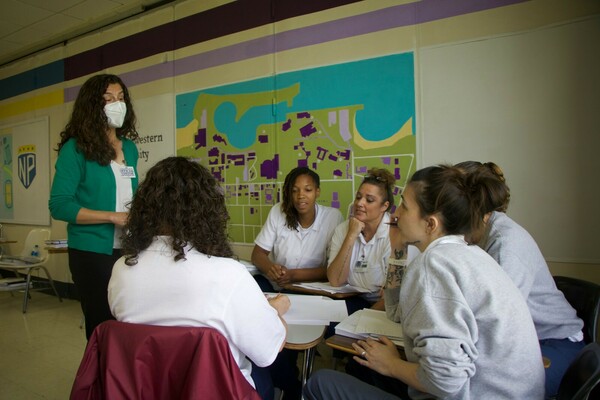
Most classrooms are empty. But on a recent weekday, one fills up with a dozen or so incarcerated women — the first female cohort of Northwestern University's Prison Education Program.
These programs are extremely rare in Illinois and around the country. While college students across Illinois have been returning to campus in recent weeks to start a new semester, there are few options for women in prison. Logan has the only liberal arts degree-granting curriculum for incarcerated women in Illinois, and experts say it is one of only a small number of similar programs in the nation.
Prison education experts like Rebecca Ginsburg, a professor at the University of Illinois Urbana Champaign, point to research showing the more education a person pursues while behind bars, the less likely they are to return.
"It doesn't serve just the individual, that's what's been so clear from decades of research," Ginsburg said. "Higher education is not an individual good. It's a good that supports all of society, all the communities. It has ripple effects all throughout Illinois when we educate somebody who's incarcerated."
The Northwestern program first started in 2018 as a pilot program for incarcerated men at the Stateville Correctional Center. It has since expanded to Logan, a women's prison a half-hour drive north of Springfield, thanks to a $1 million grant from the Andrew W. Mellon Foundation.
Aside from the program, the Illinois Department of Corrections mostly offers limited basic education or a small number of vocational courses to incarcerated women. There were once more degree-granting programs in prisons, but in 1994 people in prison lost eligibility for Pell Grants, the main federal financial aid program for low-income students.
The loss of Pell Grants forced many postsecondary prison education programs to shutter as most relied on federal funding, Professor Ginsburg explained.
Ginsburg expects this number to grow next year as the U.S. Department of Education plans to restore Pell Grant eligibility for students in prison.







 Tweet
Tweet  Share
Share


0 Comments